
A web command center for strategic career operations—applications, structured professional identity, network CRM, and an LLM orchestrator that plans, validates, and persists.
Architected and engineered by Ali Esfandyari
2026
Career-Hub AI — command center for career intelligence
Overview
Career-Hub AI is a web application that turns fragmented job search work into a single, data-driven workspace. It tracks applications in a pipeline, maintains a structured "super-resume" and evidence vault (Bio-Vault), runs a professional Network CRM with referrals and outreach drafts, and exposes a global assistant powered by Google Gemini. The assistant does not stop at chat: it emits a structured plan, validated with Zod, that the server executes against Supabase so insights and updates land in the right tables under Row Level Security.
In one line: a full career dashboard that unifies Apply Hub, Bio-Vault (smart resume + targeted CV generation), network CRM with referral workflow, and a Gemini-backed orchestrator—built on Next.js 14, Supabase, and secure RLS-backed data ownership.
Interface previews
High-fidelity light-theme concepts for major modules—layout, glass surfaces, and teal accents as in the product design system.
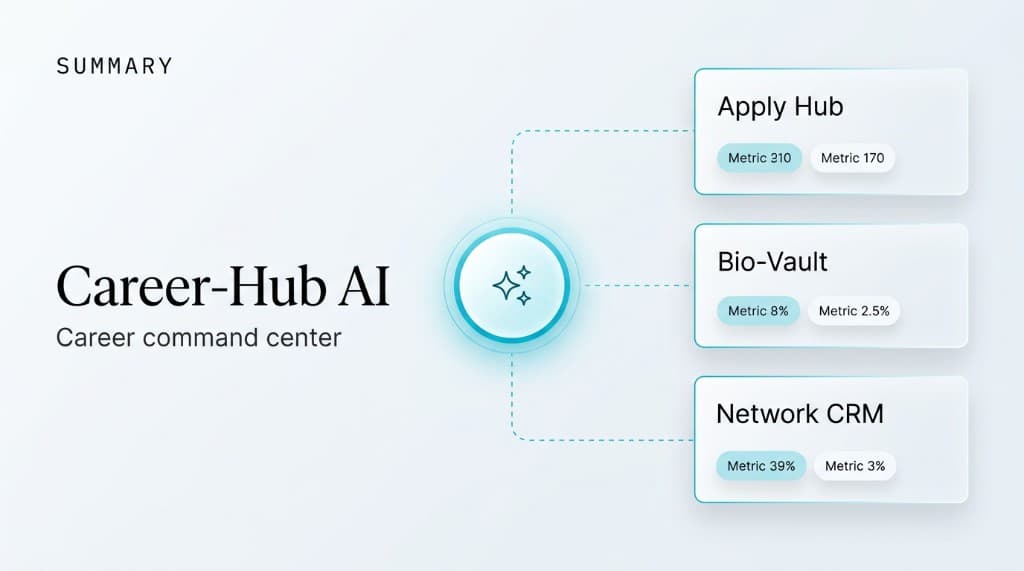
Summary
Orchestrator hub
Dashboard row with a central command node, dashed connectors, and pillar cards for Apply Hub, Bio-Vault, and Network CRM—mirroring how orchestration fans out into the three workspaces.
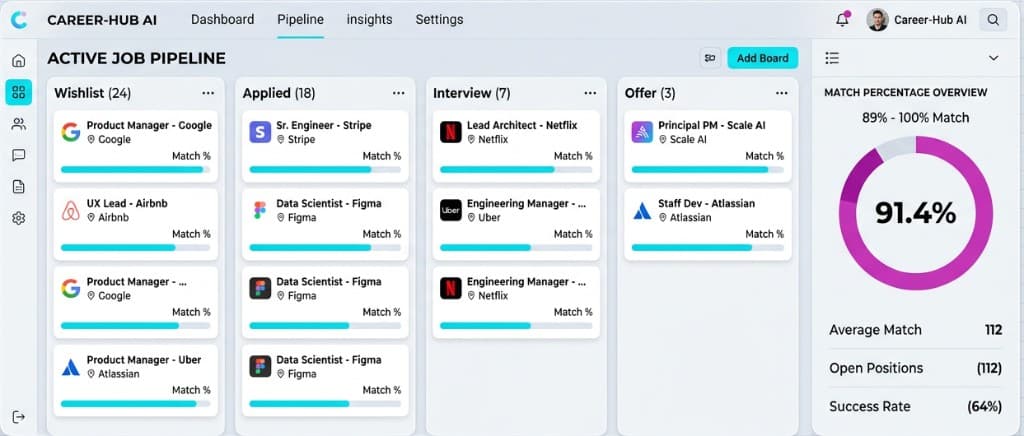
Apply Hub
Active job pipeline
Kanban across Wishlist, Applied, Interview, and Offer with per-card match strength, company context, and a side analytics strip with aggregate match and funnel signals.
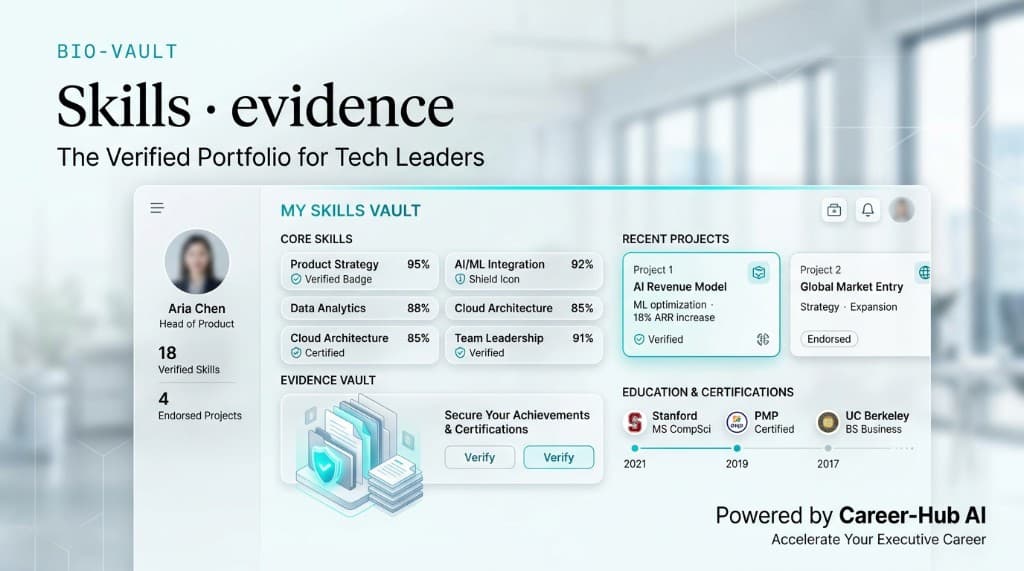
Bio-Vault
Skills and evidence
Structured professional vault: verified skills, evidence blocks, project tiles, and education/certification timeline—built for a single source of truth before job-specific exports.
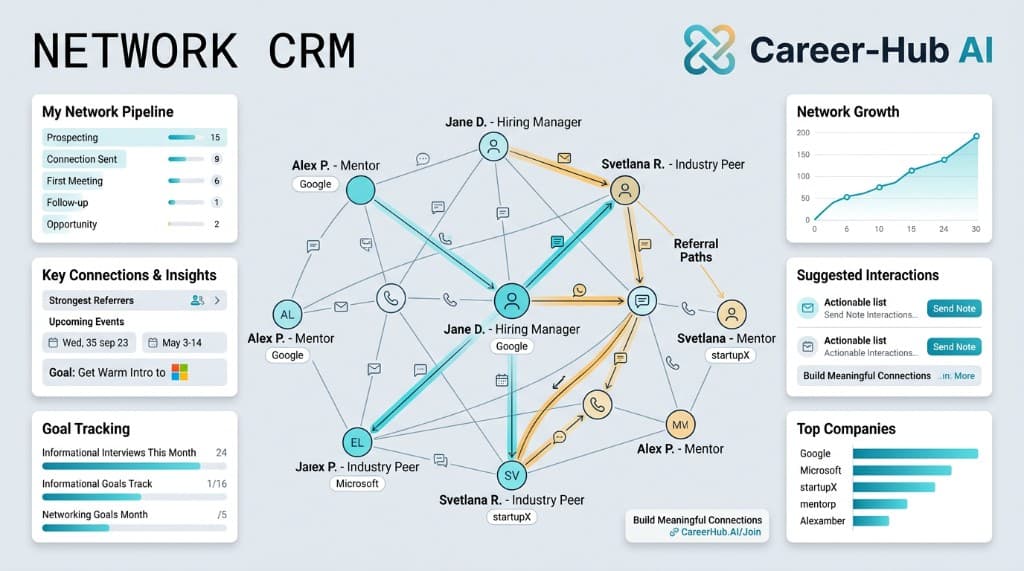
Network CRM
Relationships and referrals
Graph-forward CRM: people and companies, referral paths, pipeline stages, and side widgets for growth and next-best actions.
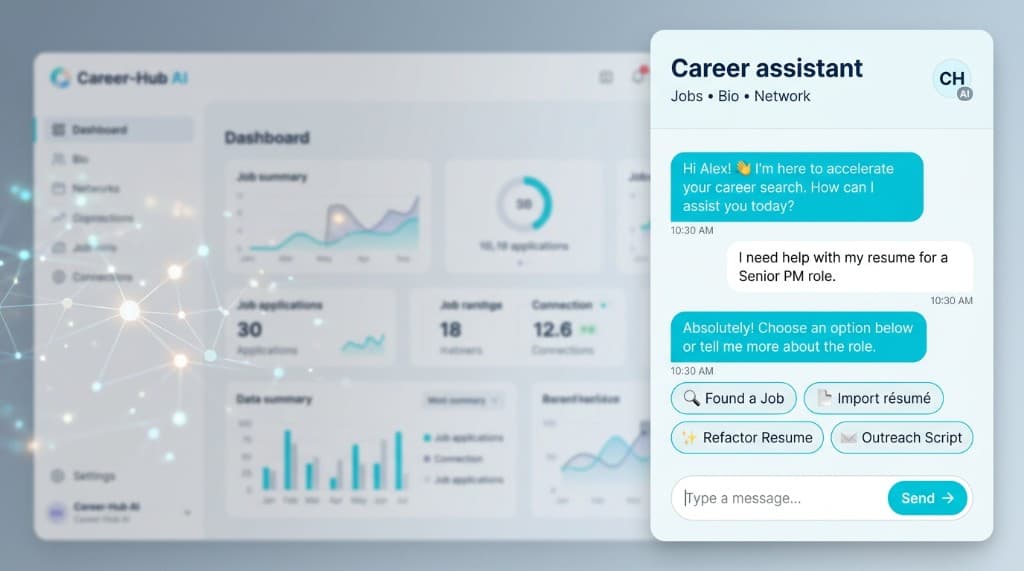
Assistant
Career assistant
Global chat layered on the dashboard with quick intents (jobs, résumé, outreach) so common orchestration flows start in one tap.
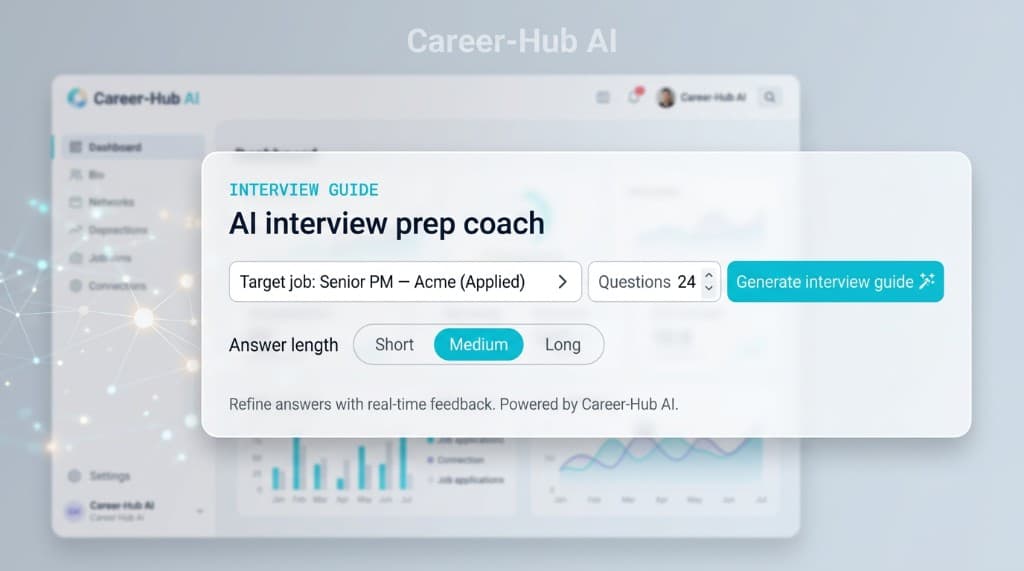
Interview Guide
Workbench setup
Choose a saved role, tune question count and answer depth, then generate a guided prep session grounded in the same profile data as the rest of the hub.
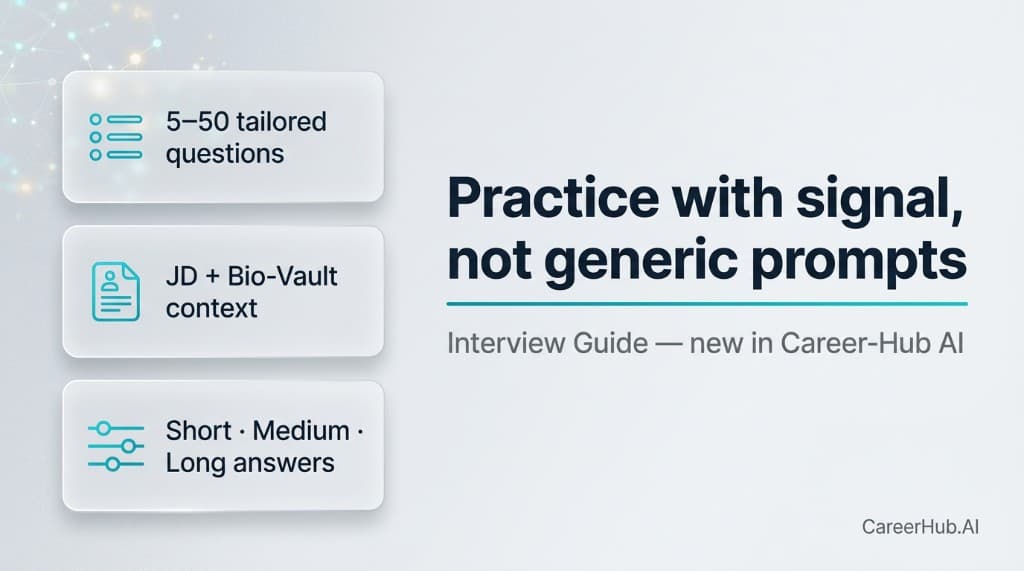
Interview Guide
Practice with signal
Positioning module: tailored question counts, JD + Bio-Vault context, and short / medium / long answer modes—so drills stay tied to real applications.
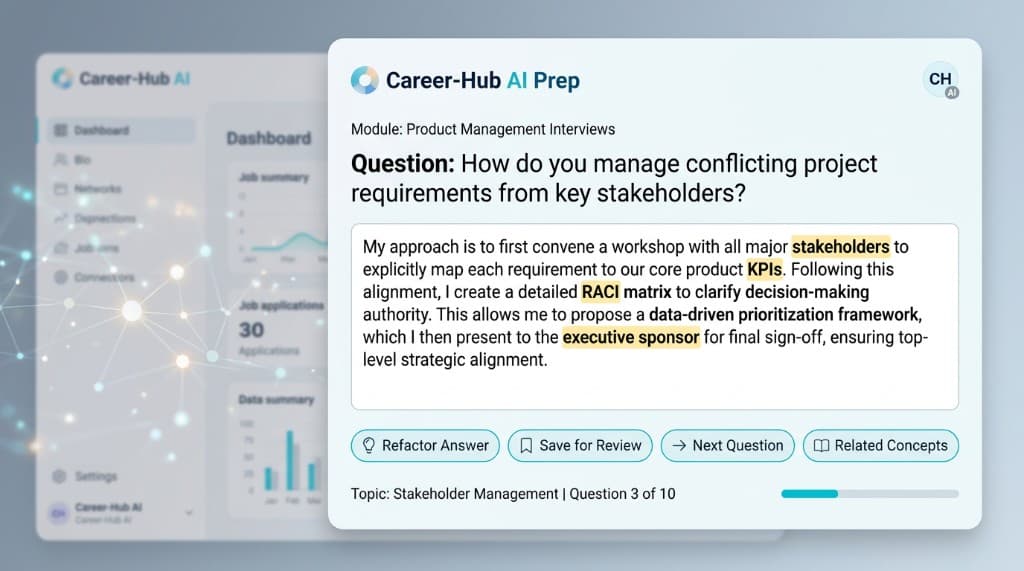
Interview prep
Coach-style review
Read a generated answer with highlighted key phrases, then refactor, save, advance, or branch to related concepts—keeping iteration inside one focused surface.
Architecture & platform
Application shape
Next.js 14 with the App Router: server rendering for primary pages and API route handlers for AI and mutations. TypeScript throughout. Hosted on a modern edge-friendly platform; long-running AI requests use extended server timeouts where the host allows.
Data & auth
Supabase provides Postgres and authentication. User data is isolated with Row Level Security on application tables. New accounts get an empty profile automatically; core entities keep last-updated timestamps for sensible sorting and sync UX.
Product surface
Dashboard
Aggregate metrics: roles, application status distribution, skills/projects/experience counts, contacts and referrals. Circular Orchestrator Hub links the three pillars (Apply, Bio, Network). Onboarding tour, empty states, sync guidance, and workspace-ready messaging.
Apply Hub
Kanban for jobs (Wishlist → Applied → Interview → Offer) with JD text and AI fields: match score, stretch skills, gap analysis, and insights. Donut summary (average match, counts, success bands). Add-job flow integrated with the orchestrator for natural-language intake.
Bio-Vault
Structured “super-resume”: profile, skills with proficiency and tools, experience blocks with bullets, projects with stack and metrics, education, certifications, languages. Chat-style input into the archive. Server-side generation of a job-tailored resume from the JD plus vault content, with optional extra focus.
Interview Guide
Pick a saved job and use an interactive workbench. Question generation, answering, and follow-ups with short/medium/long response depth. Context draws on profile, skills, experience, and projects.
Network CRM
Contacts with rich fields including AI-derived expertise signals. Job referrals with a simple pipeline (identified → asked → referred → closed) plus outreach drafts. Paste a profile or bio text and let the model suggest structured contact fields for review.
Career Assistant / Orchestrator
Global assistant chat produces a validated structured plan (intents such as job description intake, skill/project updates, networking, outreach drafts, general Q&A). The server applies approved updates to the database—match scoring, stretch/gap summaries, networking drafts—with confidence hints and suggested next steps in the UI.
Authentication
Supabase-backed sign-in. Middleware keeps sessions fresh and avoids unnecessary work on static assets.
Internal operations (admin)
Separate admin session for operational visibility into usage and connectivity—restricted to approved operator accounts.
AI & reliability
Orchestrator responses are shaped as JSON and validated with Zod before any database writes, reducing "chat-only" drift and unsafe mutations. Gemini calls use a resilient multi-model fallback when a provider returns errors or rate limits.
Skill matching uses a dedicated fuzzy layer (normalization, overlap, matched vs missing buckets) when comparing job descriptions to Bio-Vault. Interview Guide responses are parsed defensively when models wrap JSON in markdown. Critical above-the-fold styles are inlined to reduce first-paint flash.
Data model
A normalized relational schema covers identity, applications, structured career evidence, CRM entities, referrals, and audit-friendly admin metadata. Row Level Security ensures tenants only read and write their own rows; elevated access is limited to explicit admin flows.
From concept to command center
One workspace for apply, profile, and network
Defined Career-Hub AI as a command center: aggregate application state, a structured professional archive (Bio-Vault), and a CRM for relationships and referrals—rather than scattered spreadsheets and chats.
Next.js 14, Supabase, and a typed orchestrator
Shipped on the App Router with route handlers for AI workloads (Vercel-friendly, extended runtime where needed). Postgres + auth via Supabase with Row Level Security on all user-owned tables. Structured LLM output validated with Zod before any database writes.
End-to-end modules plus admin observability
Delivered dashboard with circular orchestrator hub, Apply Hub Kanban with AI match fields, Bio-Vault super-resume and job-targeted resume generation, Interview Guide workbench, Network CRM with referral pipeline, global assistant chat, and restricted admin views for operational insight.
Stack & tooling
Career-Hub AI
Private product codebase. Try the live app on careerhub.alisfand.com. For collaboration or a deeper walkthrough, reach out via the links in the site footer.
Open live demo